
THE LIFEBLOOD OF AN
ISOLATED COMMUNITY
The Howard Brothers’ Store in Howardstown, Kentucky
Local commerce • Authority • Self-reliance along the Rolling Fork
Introduction
In the early years of the twentieth century, a traveler approaching Howardstown from the direction of New Haven would have followed a narrow road that dipped and climbed through the Knobs of southern Nelson County. The landscape was one of conical shale hills rising three or four hundred feet above narrow valleys, their slopes clothed in hardwood timber, their bottoms rich with corn and tobacco. At the center of this pocket of land lay the Rolling Fork River, the southernmost major branch of the Salt River system, a stream that both sustained and periodically imprisoned the people who lived along its banks. When the river rose, fords became impassable and the community could find itself cut off from neighboring towns for days or even weeks. In that isolated world, one building stood as the indispensable center of daily existence: the Howard Brothers’ general store.
The store was more than a place of commerce. It was the post office, the only telephone connection, the source of credit, the market for farm produce, the supplier of coffins and shrouds, and the informal clearinghouse for news, dispute, and mutual obligation. To understand the role of the Howard Brothers’ Store is to understand how a remote rural community in post-Civil War Kentucky organized its economic, social, and informational life when formal institutions of government and finance remained distant.
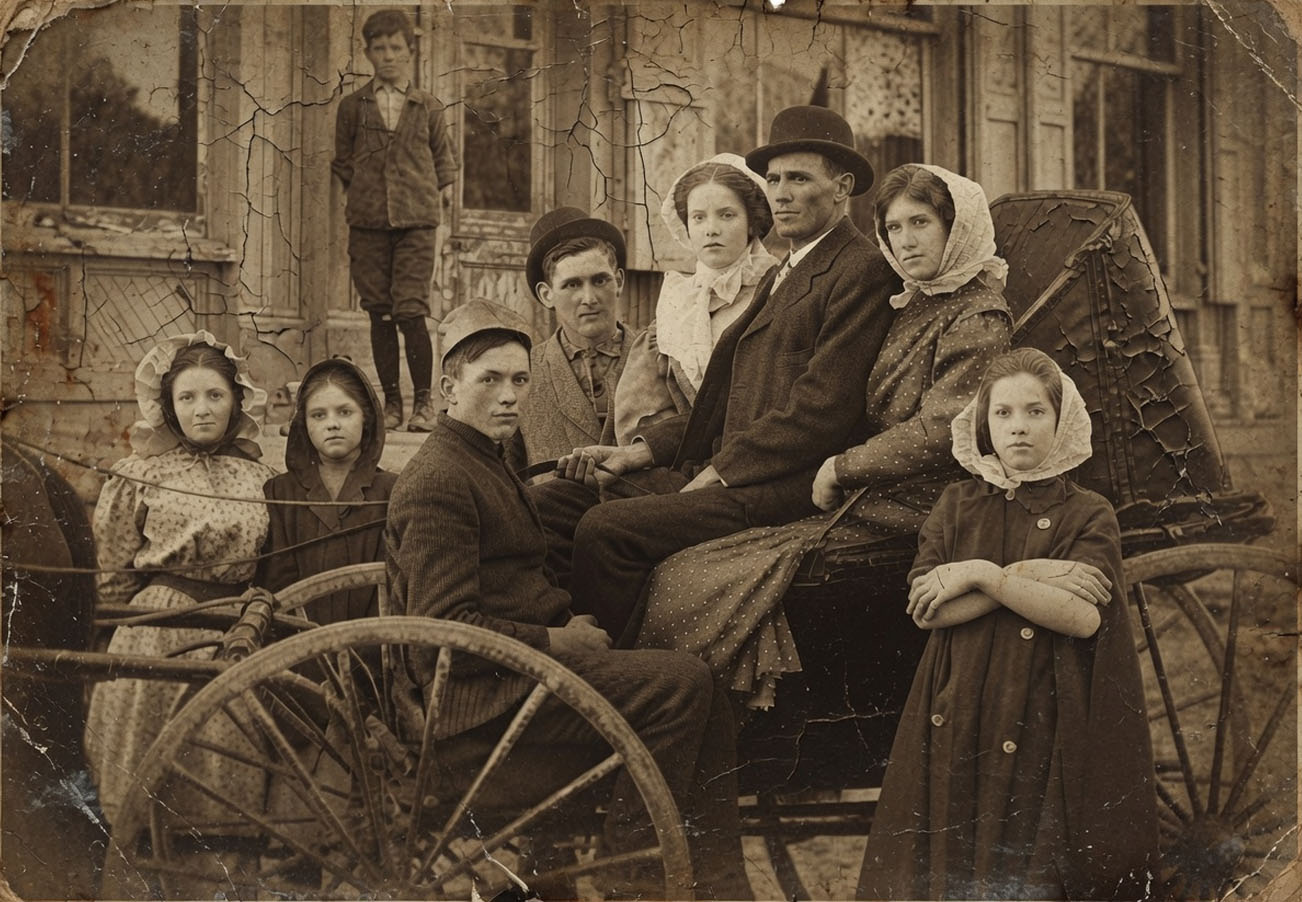
A Howardstown family posed in a horse-drawn carriage, circa 1918. Multi-generational portraits reveal the close kinship networks that underpinned the community centered on the store.
Geography, Isolation & the Making of a Community
Howardstown occupied a physiographic and social niche that shaped every aspect of its existence. Located at the western edge of the Outer Bluegrass in the region known as the Kentucky Knobs, the settlement sat more than half a mile from the Rolling Fork itself, eight miles from New Haven, and over twenty miles from the county seat of Bardstown. The valley floor offered fertile ground, but the surrounding hills and the river created natural barriers. Residents of neighboring Larue County sometimes crossed the river on foot by means of a pedestrian swinging bridge when water levels made the fords dangerous. High water could sever ordinary contact for extended periods, rendering the community temporarily self-contained. In such circumstances, the presence of a single, well-stocked, multi-functional commercial house assumed extraordinary importance.
The community itself traced its formal identity to the mid-nineteenth century. Earlier known as Lunar, the settlement received a post office in the 1880s and adopted the name Howardstown in 1883, reflecting the prominence of the Howard family, descendants of early Catholic settlers from Maryland who had acquired substantial land along the Rolling Fork in the 1830s. Joseph Howard and his sons had established successive mills—first a treadmill, then water-powered, and eventually steam-powered operations—that processed grain and timber for the surrounding countryside. By the final decades of the century the family’s commercial ambitions had expanded beyond milling into general merchandising, farming, stock trading, and telephone communication. The general store became the visible expression of that diversified local power.

THE PHYSICAL EVOLUTION OF THE STORE
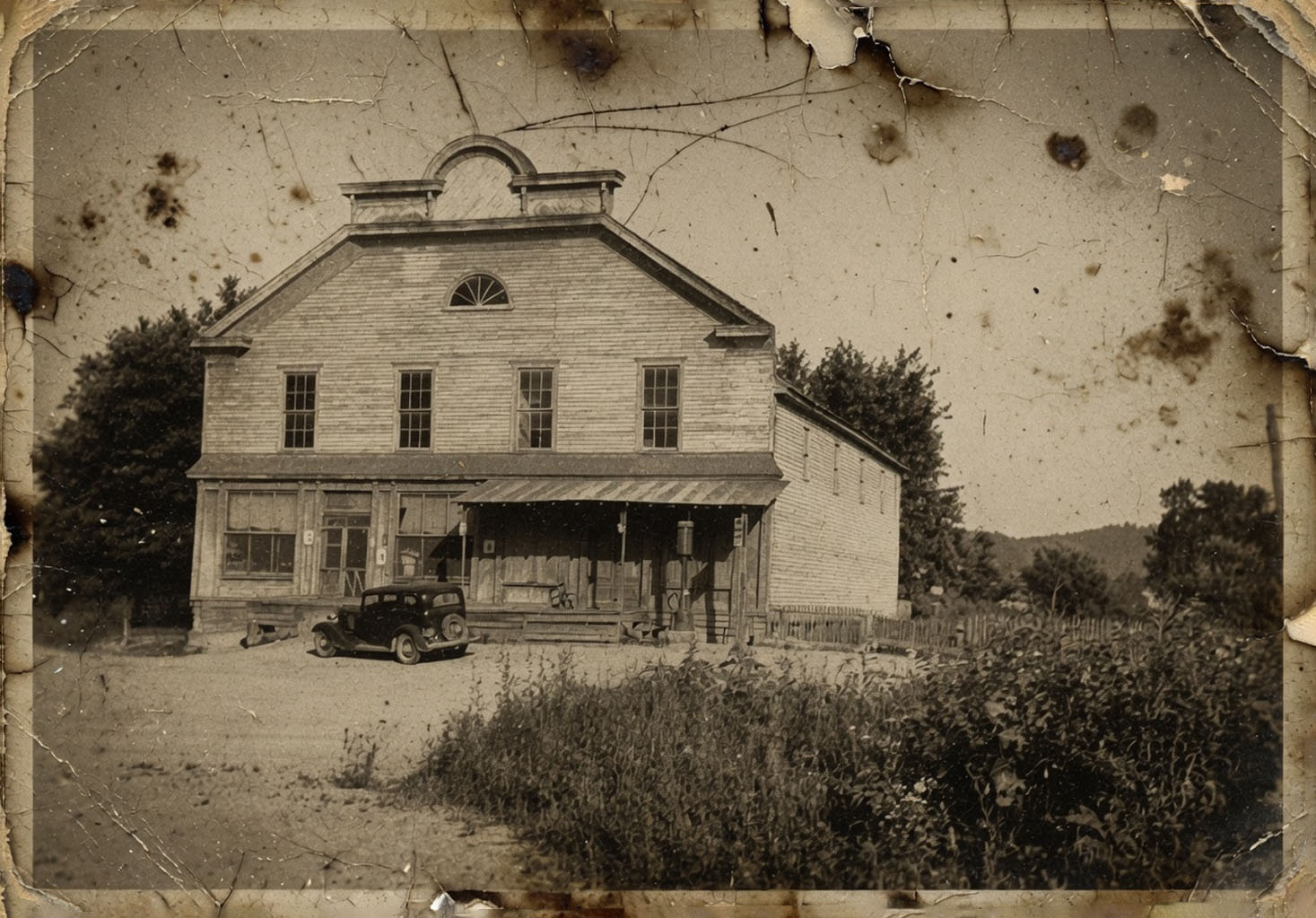
The building that would dominate Howardstown began life as a modest two-story frame structure, approximately 24 by 50 feet, erected near the river around 1880. In 1899 the Howard brothers undertook a remarkable relocation. They moved the store, still filled with goods, half a mile inland on rollers pulled by a steam engine. Contemporary observers recorded the curious spectacle of customers following the migrating building across the fields, continuing to make purchases while it advanced. Once repositioned on the pike near the center of the settlement, the structure was substantially enlarged. By 1900 it measured 54 by 75 feet and rose two-and-one-half stories under a gabled tin roof capped with a decorative ridge of reticulated heart motifs. An addition created unequal floor and eave heights that the designers skillfully masked with an elaborate wooden façade. Pilasters, scrolled brackets, panels of angled beaded board, a short mansard section sheathed in fish-scale shingles, and a distinctive arched and balustraded pediment combined to produce one of the most architecturally ambitious rural commercial buildings in Kentucky.
Family members supplied both capital and craftsmanship. Sam I. Howard is credited with the overall design and with mechanical innovations that included a weight-driven freight elevator serving the upper floors. Boone C. Howard, recognized as a master carpenter and joiner, executed the fine cabinetry, shelves (including a dedicated pharmacy section), and much of the exterior woodwork. The finished store contained roughly five thousand square feet of floor space. The ground floor housed dry goods, groceries, and farm equipment; upper levels held clothing, horse collars, side meat, and, for a time, a furniture showroom later converted into a skating rink.
ECONOMIC FUNCTIONS: MERCHANDISE, BARTER & PRIVATE CURRENCY
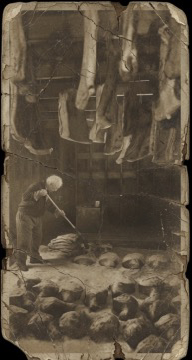
The store’s inventory reflected the comprehensive needs of an isolated agrarian community. Customers could obtain calico and gingham, groceries, tools, Hayes horse collars, men’s pants and coats, drugs, and farm implements. More unusually for a rural general store, the Howards kept a stock of wood coffins and women’s shrouds and operated a small hearse drawn by family animals. A former clerk, John Uptegrove, who worked in the store around 1905 for ten dollars a month plus room and board, recalled being sent to retrieve coffins from the third floor and to convey bodies to local cemeteries. On one occasion he was required to close the mouth of a deceased woman before the viewing. F. M. (Milburn) Howard occasionally pulled teeth without charge.
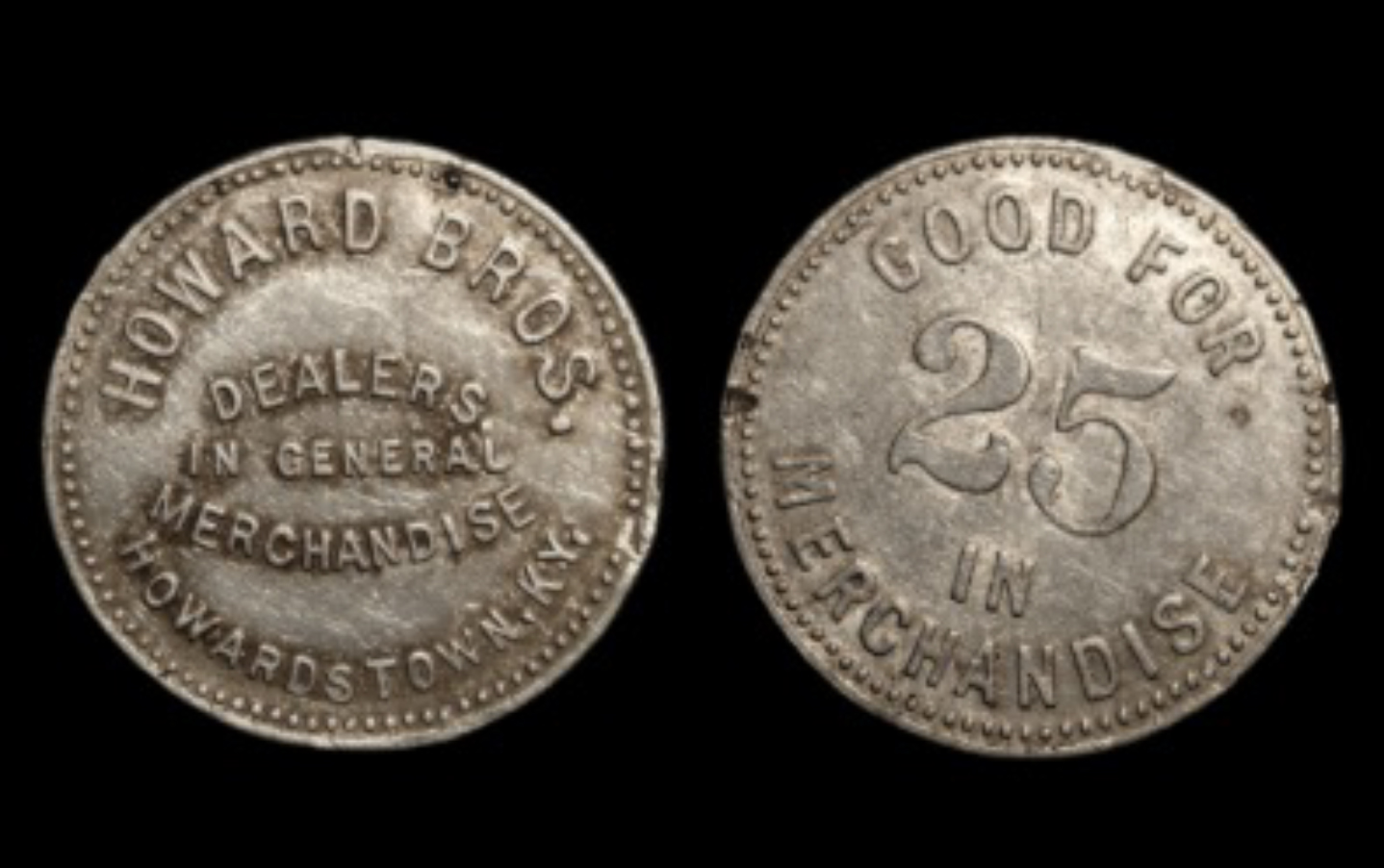
Transactions frequently occurred outside a pure cash economy. Farmers brought eggs, chickens, butter, and other produce; the store accepted these goods in exchange for merchandise or credit. Hucksters sometimes arrived offering cash for poultry, but many residents preferred or were compelled to operate within the store’s internal system. The existence of Howard Brothers merchandise tokens, struck with the firm’s name on the obverse and “Good for 25¢ in Merchandise” on the reverse, provides concrete evidence of this private currency. Such tokens were common among rural American merchants in the late nineteenth and early twentieth centuries precisely because hard money was scarce. By issuing tokens redeemable only at their own establishment, the Howards kept value circulating locally and reinforced customer dependence on the store.
The firm’s reach extended well beyond the store counter. Willard Howard directed extensive farming operations; Boone managed milling; Sam oversaw machinery and the telephone system; and William E. Bell, who had married Lila Howard, engaged in stock trading. The brothers bought and sold livestock, rented land and mill properties, and extended loans secured by mortgages. During the Prohibition era the store’s isolation became an economic advantage. It sold ready-ground grain, hauled daily by wagon from Bardstown mills, to as many as fourteen customers engaged in illicit distillation—a continuation of the Rolling Fork’s long whiskey tradition under new legal conditions.
INFORMATION, COMMUNICATION & THE POST OFFICE
Perhaps no function of the store was more critical than its role as the community’s primary link to the outside world. A post office had been established at Howard’s Mill under the name Lunar in the 1880s; by 1889 it operated from the store itself, with the merchant frequently serving as postmaster. Mail arrived on a limited schedule—sometimes every other day—and the irregularity of service is repeatedly noted in contemporary newspaper items and family letters. When the river rose, even this tenuous connection could be interrupted. In such periods the store became the sole reliable point of contact for letters, money orders, newspapers, and official notices.
Sam Howard’s telephone line further concentrated communication. He strung a line from the railroad depot in New Haven to Howardstown so that he could verify the arrival of freight before making the trip to town. For ordinary residents this line represented the only rapid means of communication available. The combination of post office and telephone meant that news of births, deaths, marriages, land sales, and distant political events first entered the community through the store. Family letters from the 1880s show Austin Howard sending small sums of money and clothing to his son Boone at school, inquiring about studies, and reporting local illnesses and deaths—all mediated by the limited postal service centered on the family’s commercial establishment.
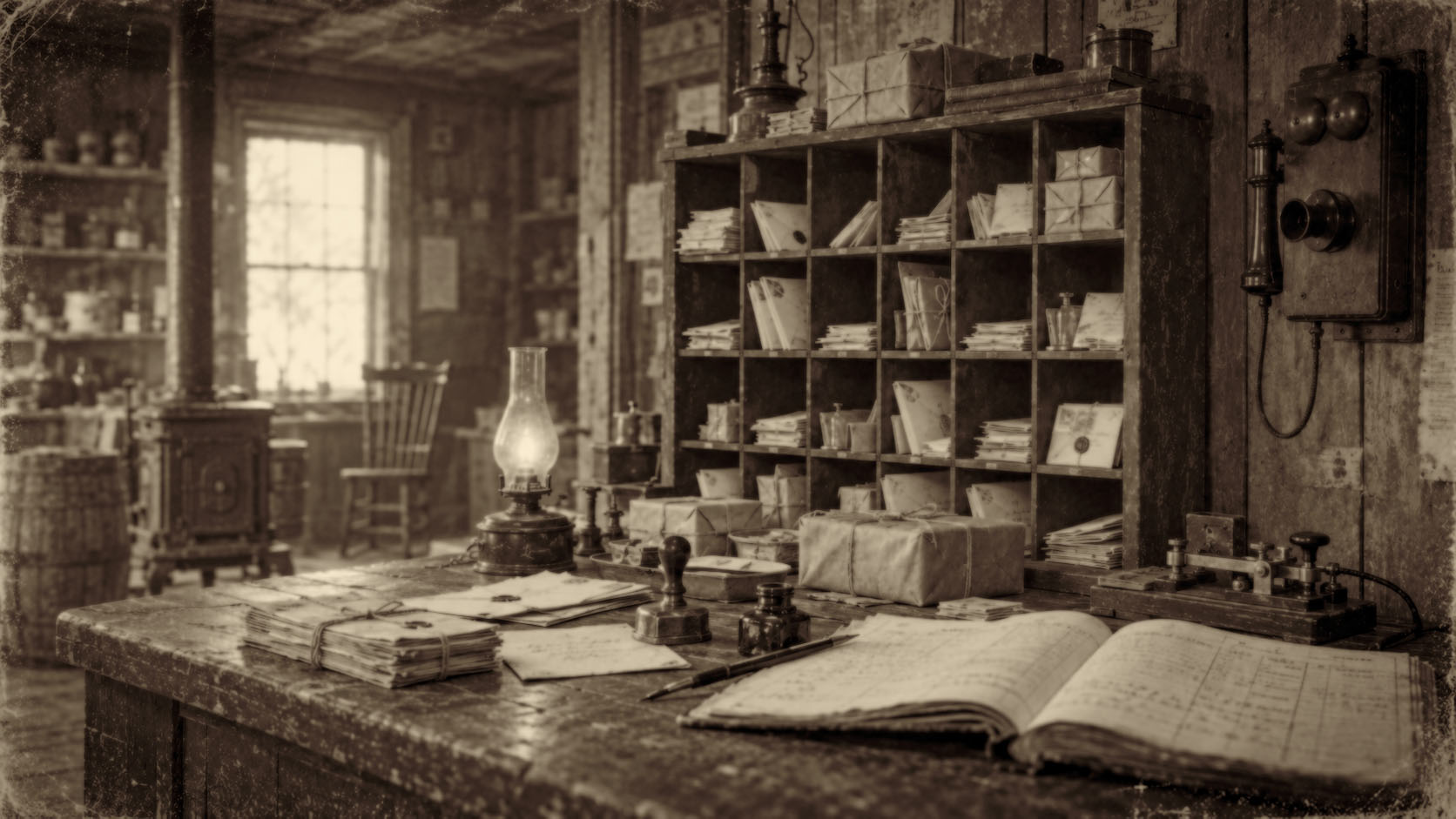
Illustration of the interior of a rural general store post office with shelves, letters, and a ledger, circa early 1900s.
“The store was the institution that made ordinary life possible.”
SOCIAL AUTHORITY & QUASI-GOVERNMENTAL FUNCTIONS
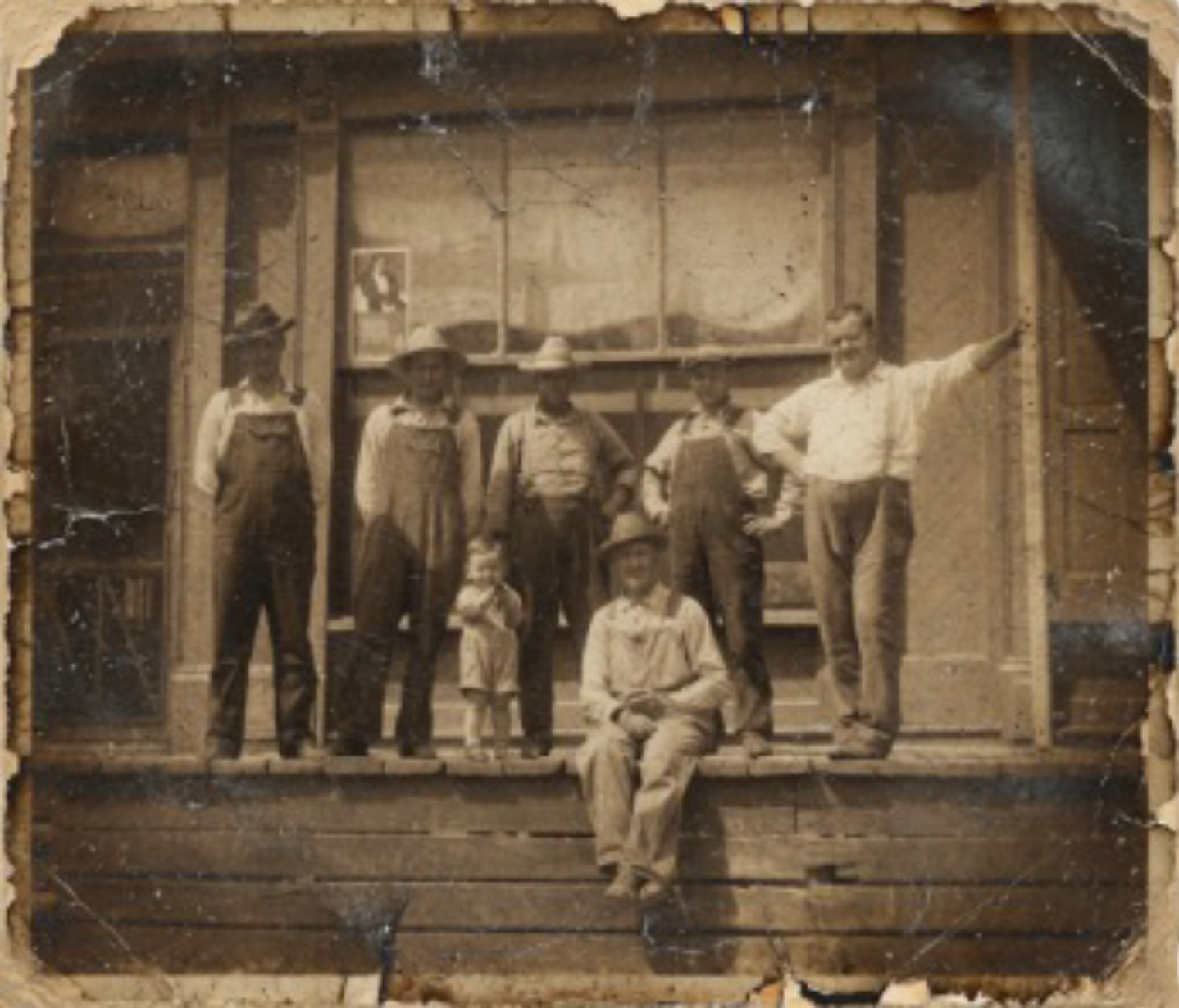
The concentration of economic and informational power inevitably conferred informal social authority. The store was the place where accounts were settled, credit was extended or withheld, and local reputations were quietly assessed. Uptegrove recalled an episode in which money began disappearing from the cash drawer. Sam Howard drilled a hole through the second floor directly above the drawer, observed the son of a prominent local family in the act of theft, marked the money, and followed the young man to a crap game. The matter was handled privately; the thief was never again allowed near the register. Such episodes illustrate how the merchants exercised a form of social regulation that complemented, and sometimes substituted for, distant county officials.
The store also served as a gathering place. People came not only to buy but to exchange news, observe neighbors, and participate in the informal public life of the community. Later conversion of the second-floor showroom into a skating rink extended this recreational function into the 1930s. Community events, literary societies, and the simple act of “visiting” all orbited the commercial center. When deaths occurred, the store supplied coffins and, on occasion, the hearse. When the river claimed lives—as in the 1915 drowning of Clara Boone and her companion near the ford—the discovery of the wreckage and the subsequent search involved local men connected to the Howard network.
This pattern of local authority must be situated within the broader context of rural Kentucky after the Civil War. Formal institutions of government, banking, and professional services thinned rapidly outside county seats and rail towns. In remote settlements, respected families and merchants filled the vacuum, organizing credit, mediating disputes, and maintaining the practical infrastructure of daily life. The Howards, through their store, mills, farms, and telephone line, occupied precisely this position. Their private tokens, their control of the post office, and their ability to function when the river isolated the community all testify to a high degree of practical local autonomy—an autonomy rooted less in ideology than in the necessities of geography and the limitations of distant government.
CONTINUITY AND CHANGE
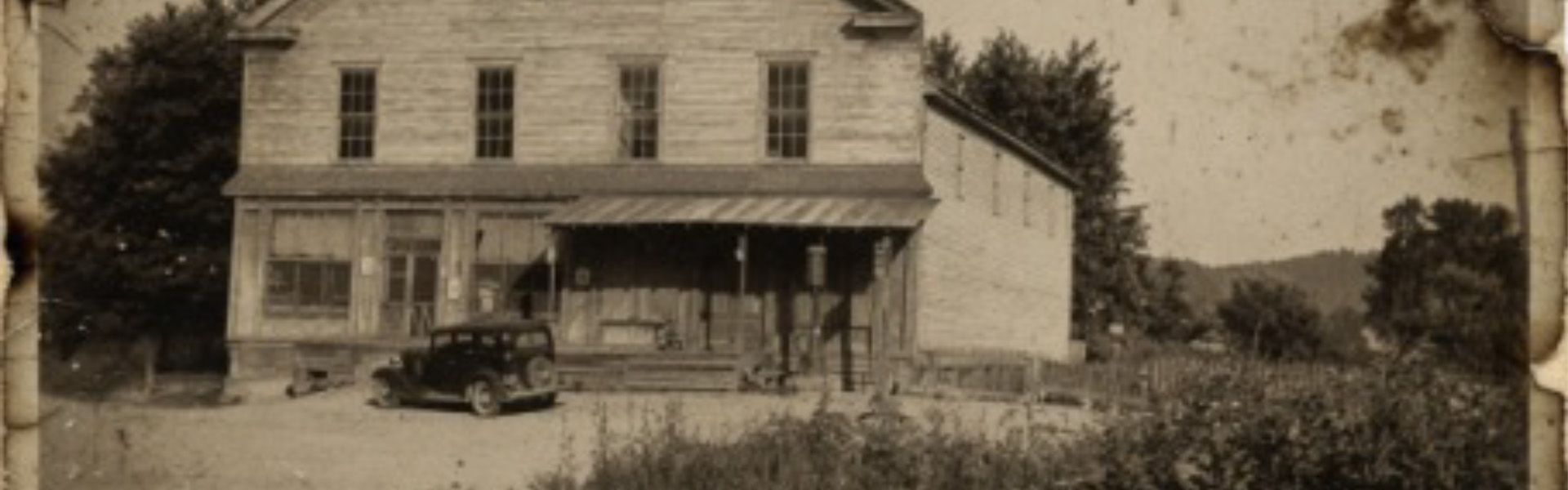
The store’s dominance gradually eroded in the mid-twentieth century. Improved roads, the automobile, the decline of local milling, and the end of Prohibition reduced the community’s dependence on a single commercial house. In 1931 the business passed to Wayne Ennis, a relative by marriage; later owners included F. M. Head, who also served as postmaster, and eventually the Bell family. The great showroom became a skating rink; the range of merchandise contracted. Yet the building retained powerful symbolic force. When later proprietors proposed painting the weathered exterior, long-time residents objected. The store, in its natural gray-brown patina, had become a visual landmark of collective memory—a structure that many had never known in any other condition.
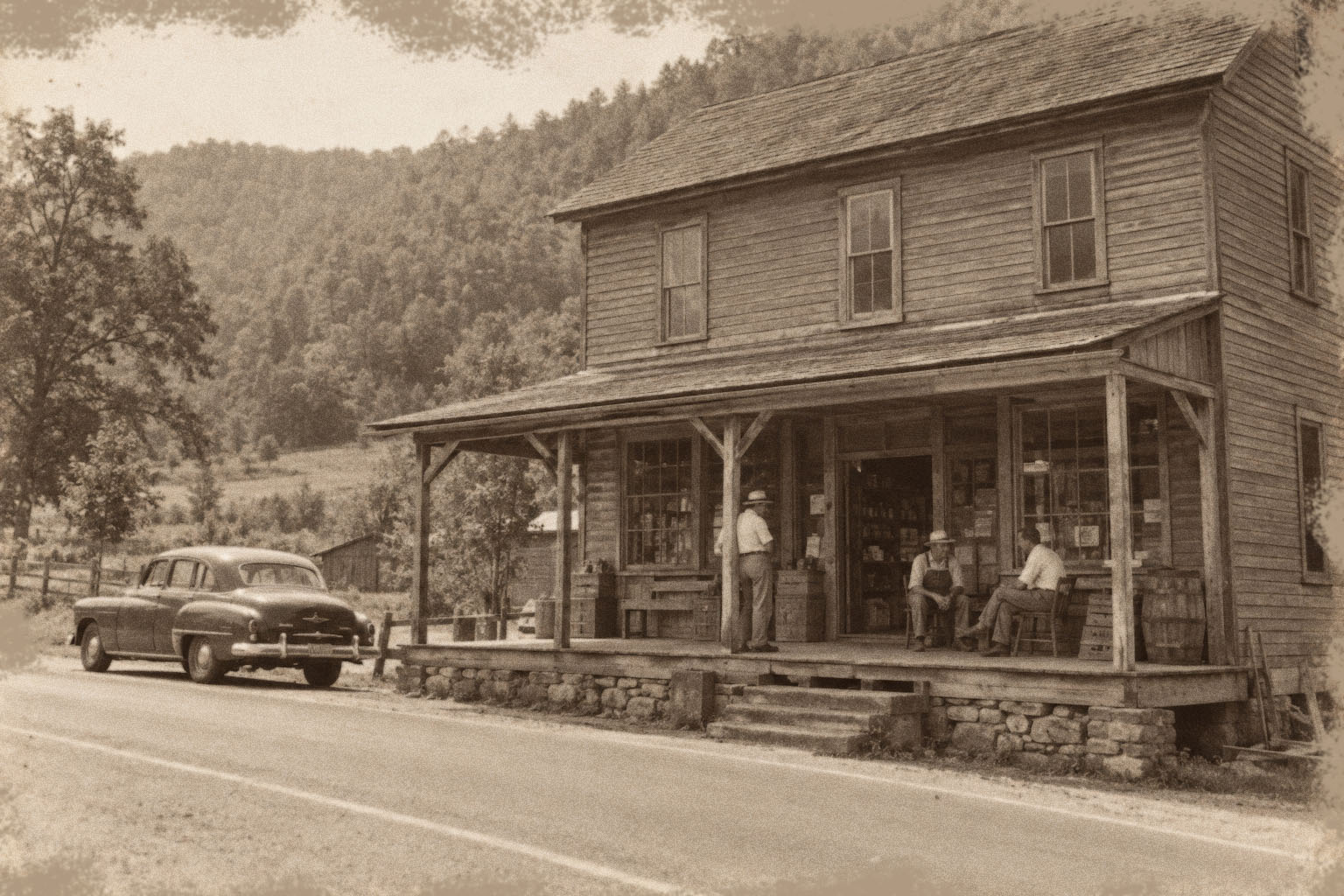
Illustration of a weathered wooden country store with people on the porch, circa 1950.
Conclusion
The Howard Brothers’ Store stood at the center of Howardstown because geography, economy, and the thin reach of formal institutions made such a center necessary. In a community that could be cut off for weeks by high water, that possessed only one telephone line, and that conducted much of its trade through barter and private tokens, the store was the institution that made ordinary life possible. It supplied goods and credit, carried the mail, transmitted news, buried the dead, and quietly regulated social behavior.
The elaborate wooden façade that still faces the road in Howardstown is more than an architectural curiosity. It is the material expression of a rural world in which a single family enterprise became the lifeblood of an entire community.
Howard Brothers’ Store • Howardstown, Kentucky
Sources
- National Register of Historic Places Inventory Nomination Form for the Howard Brothers’ Store, Nelson County, Kentucky (hereafter NRHP Nomination); contemporary and oral accounts of river isolation.
- NRHP Nomination, location data: approximately eight miles from New Haven and twenty-one miles from Bardstown.
- NRHP Nomination and local oral history regarding the pedestrian swinging bridge used by Larue County residents during high water.
- Local postal and settlement history; name change to Howardstown in 1883; Joseph Howard’s land acquisition circa 1831.
- Kentucky Standard (Bardstown), May 23, 1901, quoted in the NRHP Nomination.
- NRHP Nomination, detailed architectural analysis of the 1900 structure.
- NRHP Nomination, citing local oral attribution regarding Sam I. Howard’s design role and Boone C. Howard’s carpentry.
- NRHP Nomination, interior description including later conversion to skating rink.
- Recollection of John Uptegrove, clerk circa 1905, preserved in local historical compilations.
- Uptegrove recollection and corroborating local accounts of free dental extractions.
- Uptegrove recollection of produce trade and huckster activity.
- Surviving Howard Bros. merchandise token; pattern of rural merchant tokens as responses to currency scarcity.
- Family correspondence of Sam and Milburn Howard (1907–1909 and later).
- Oral history related by Paul Howard (grandson of F. M. Howard) concerning Prohibition-era grain sales.
- Post office history: establishment as Lunar and subsequent operation from the store.
- Kentucky Standard, May 23, 1901, and local accounts of Sam Howard’s telephone line.
- Austin Howard letters to Boone Howard, 1883–1885.
- Uptegrove recollection of the cash-drawer theft and private resolution.
- Kentucky Standard, January 14, 1915, account of the drowning of Clara Boone.
- Oral history from F. M. Head and other long-time residents regarding resistance to painting the store.