
Why Do You Keep Calling My Whisky Bourbon?
Whisky in the Making Counties, a County Name on the River, and the Federal Label
A Rolling Fork argument, with the newspapers and barrel heads still attached
Revised and expanded edition, with notes
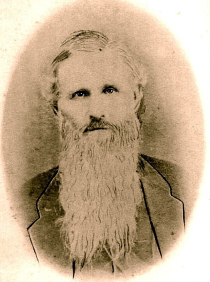 He is my fourth great-grandfather. Joseph Edward Howard — Old Uncle Joe to the neighborhood — miller, town-founder, the man Howardstown was named for. Born on the Fork in 1799. Died at Howard’s Mill in 1879. Scotch-Irish to the bone. The house he came out of made whisky. That was the word on the creek, the word on the barrel head, the word a man used for what his people had been cooking since there was a name for the drink.
I never met him. I bottle what he made. I own Uncle Boojie’s Distilling Co. in Louisville, and the federal line on my label has to say bourbon. His would not have. Walk up to that beard and call his barrel by the name I am required to print, and he would have knocked you silly, or looked at you as if you had gone plumb crazy. The word was not his. The craft was. What went in the barrel was an inheritance, not a brand. Nobody on this water needed a French county or a New Orleans invoice to know what they had made. The only two things that ever forced a different name onto that liquid were money on the river and the government on the label. I live with both.
Tourism talks as if Kentucky has always called the drink bourbon. The word is on every bottle and every trail sign. That is not how we talked at home. Two vocabularies ran side by side for most of the nineteenth century. Distillers in Nelson and LaRue stamped whisky, sour mash, and fire copper on their barrel heads. Commission merchants at Maysville and Natchez sold the same class of goods as Bourbon County whiskey and, soon enough, as old Bourbon. The consumer bottle was forced to choose only after Repeal, when federal labeling rules required a class-and-type line. What follows is that proof, in this order: the writers who explained the name, the river advertisements of the 1820s, Elliott’s 1896 county supplement, the 1889 Atherton brand facsimiles, the Bottled-in-Bond Act of 1897, the rectifier wars that made that Act necessary, Taft’s 1909 whiskey decision, the 1935–36 labeling regulations and the silence of the Kentucky senators who might have claimed the word, the Bardstown labels that changed after Repeal, and the 1964 congressional resolution that turned a river merchant’s mark into a national asset. The fun is in the question. The proof is in the stamps.
Serious writing on the name has spent fifty years circling a single inconvenience. The original Virginia county called Bourbon was huge. After Kentucky entered the Union in 1792 it was carved into more than thirty counties. By the Civil War, when “bourbon” had become a trade word for Kentucky corn whiskey, almost none of the surviving stills sat inside the small county that kept the name. From Prohibition until 2014 there were none at all.
Gerald Carson, in The Social History of Bourbon (1963), treated “bourbon” as a loose regional tag for northeastern Kentucky. Charles Cowdery and Henry Crowgey pushed the same line further: “Old Bourbon,” they argued, named the old county, not the age of the barrel. Other writers left the county altogether. Reid Mitenbuler suggested the word was aimed at French-speaking New Orleans. Michael Veach wondered whether river men asked for “Bourbon Street whiskey.” Those theories all start from the same premise—that the small county cannot bear the name—and they all treat “bourbon” as if it were already the ordinary word for what Kentucky made.
The newspapers of the 1820s do not support that premise. They support a simpler one. When a merchant in Natchez or New Orleans wrote “Bourbon County whiskey,” he meant whiskey from Bourbon County, Kentucky. When he wrote “old,” he meant the barrel had sat.
The earliest advertisement now generally cited for bourbon as the name of the drink appeared on 1 May 1821 in the Western Citizen of Paris, Bourbon County. Stout & Adams, commission merchants of Maysville, offered “Bourbon Whiskey” by the barrel. Maysville, the old Limestone landing, had been cut out of Bourbon County when Mason County was created in 1788–89. It remained the Ohio River port for the old Bourbon country. Whiskey that reached that wharf kept the county name the way Pennsylvania rye kept Monongahela.
Three years later the word is no longer a slogan. It is a place of origin printed in full. On 7 August 1824, S. & H. P. Postlethwaite of Natchez advertised “100 Barrels Superior Bourbon County Whiskey,” and named the goods: “‘Spears’ & other brands.” That is one of the first times a Kentucky distiller’s name is used as a brand on the lower Mississippi.
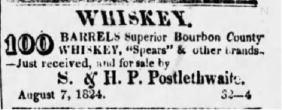
S. & H. P. Postlethwaite advertisement, Natchez Gazette, 7 August 1824. Scan reproduced from Robert F. Moss,
The same formula repeats. Sturgus & Miller sold “200 barrels superior quality Bourbon county, Ky. Whiskey.” J. W. Trembly, at Natchez Landing in January 1826, offered “50 barrels Old Bourbon County Whiskey.” New Orleans papers listed flatboats in from “Bourbon county, Ky.” with tobacco, bacon, flour, and whiskey in the same cargo. Bourbon County sat inland, but it reached the Ohio by the Licking the county’s flour was already advertised as the best wheat in Kentucky. Its whiskey traveled the same way.
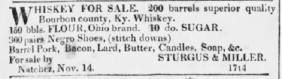
Sturgus & Miller advertisement, Natchez, 14 November 1825. Scan reproduced from Moss, 2020.

J. W. Trembly advertisement, Natchez Landing, 23 January 1826. Scan reproduced from Moss, 2020.
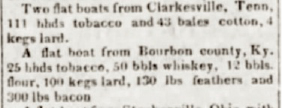
Flatboat arrival notice from Bourbon County, Ky. Louisiana State Gazette, 12 April 1824. Scan reproduced from Moss, 2020.

Flatboat arrival notice from Bourbon County, Ky. Courrier de la Louisiane, 17 April 1826. Scan reproduced from Moss, 2020.
Who was Spears? Jacob Spears distilled northwest of Paris, in the small Bourbon County that still exists. Local institutional histories give his marketed name as “Best Old Whiskey,” not “bourbon.” Moss reads the 1824 invoice as likely Solomon Spears, the son. Either way the pattern is the same. The maker’s house word is whiskey. The river word is Bourbon County.
The phrase “old whiskey” is everywhere in early-nineteenth-century trade copy, often with a place name: old Monongahela, old Susquehanna. Merchants sometimes stated the years. In Maysville itself, H. I. De Bruin offered “OLD BOURBON WHISKEY, by the bbl.” and, separately, “a few bbls. of 3 YEARS OLD BOURBON WHISKEY.” That notice is fatal to the claim that “Old Bourbon” can only mean the former large county. Three years old is a number.
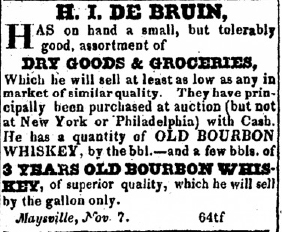
- I. De Bruin advertisement, Maysville Eagle, notice dated 7 November 1827. Scan reproduced from Moss, 2020.
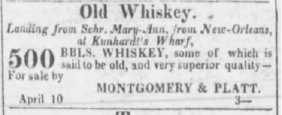
Montgomery & Platt advertisement, Charleston Daily Courier, 10 April 1827. Scan reproduced from Moss, 2020.
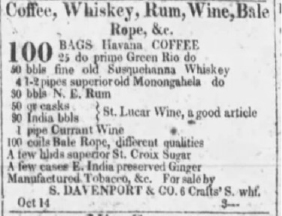
- Davenport & Co. advertisement, Charleston Daily Courier, 14 October 1828. Scan reproduced from Moss, 2020.
None of this yet makes bourbon the working name in Nelson County. It makes it a shipping name for goods associated with Bourbon County and with the Maysville landing. Over the next two generations the “County” falls off, and the word is applied to Kentucky corn whiskey more generally. That is branding in the strict sense: a place-name attached by merchants to barrels in transit.
Sam Carpenter Elliott’s New Year 1896 supplement to The Nelson County Record is a county industrial survey printed in Bardstown. It is not a cocktail book and it is not writing for New Orleans. In the distillery sketches that survive in transcription, Elliott writes whisky and whiskey. Wattie Boone and Stephen Ritchie “began making whisky” on Pottinger’s Creek and the Beech Fork. Boone Bros. produced “this fine whisky” under the brands Boone Bros. and Old Maid. John H. Beam’s Early Times plant manufactured “Kentucky Whiskey’s” and “pure, old fashioned, handmade, sourmash whiskey,” sold as Early Times, A. G. Nall, and Jack Beam.
Elliott’s Boone claim is local tradition, not a proven statewide first. Distilling was already under way at Harrod’s and elsewhere in the 1770s. What the sketches prove is vocabulary. In 1896 the largest whiskey-making county in Kentucky still named the liquid as whisky. That is the speech of the Rolling Fork: Scotch-Irish whisky, not a French county name borrowed for the New Orleans trade. If Boone is this valley’s first commercial maker, whisky is the inherited word. Bourbon is not. Nobody on Pottinger’s Creek needed a Paris, Kentucky, shipping label to know what they had cooked.
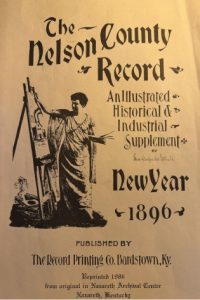
Cover of The Nelson County Record: An Illustrated Historical & Industrial Supplement, New Year 1896, Sam Carpenter Elliott. Record Printing Co., Bardstown. Reprinted 1986 from the original in the Nazareth Archival Center.
John M. Atherton’s plants sat a few miles from Boone’s country, at Athertonville on Knob Creek in LaRue County, addressed through New Haven in Nelson. By the late nineteenth century the firm was among the largest whiskey operations in the United States. Facsimiles of its barrel brands, published in the Meyer Brothers Drug Co. catalogue of 1889, make Elliott’s point in iron.
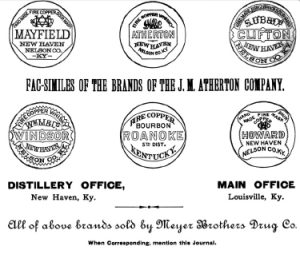
Facsimiles of the brands of the J. M. Atherton Company. Meyer Brothers Drug Co. catalogue, 1889.
Five of the six heads talk like Nelson County. Mayfield, Clifton, and Howard are “Hand Made Fire Copper Sour Mash,” New Haven, Nelson Co., Ky. Atherton and Windsor are “Fire Copper Whisky,” same place. Only Roanoke reads “Fire Copper Bourbon,” and it drops the county line for “5th Dist. Kentucky.” Roanoke was the wholesale brand Atherton sold through houses such as Meyer Brothers. The home stamps kept whisky. The export stamp borrowed the trade word.
That single exception is the hinge of the argument. By 1889 bourbon already existed as a tool a large maker could pick up when he sold into the drug-trade catalog. He did not put it on Mayfield, Atherton, Clifton, Windsor, or Howard. The making counties still had a choice. They used it sparingly.
AN ACT TO ALLOW THE BOTTLING OF DISTILLED SPIRITS IN BOND
3 March 1897 · Chapter 379 · 29 Stat. 626
The Bottled-in-Bond Act of 3 March 1897, chapter 379, 29 Stat. 626, is titled “An Act To allow the bottling of distilled spirits in bond.” It requires the real name of the bona fide distiller, a single distilling season, no alteration except reduction with pure water to one hundred proof for domestic bottling, and a government strip stamp. It does not use the word bourbon. It does not use whiskey. The first national purity statute for bottled American whiskey therefore refused the type name that city markets already knew.
─── “It does not use the word bourbon. It does not use whiskey.” ───
The Bottled-in-Bond Act did not appear out of nowhere. It was the product of a thirty-year fight between straight-whiskey distillers and the rectifiers who bought their bulk spirit—or neutral spirits from continuous stills—and sold it back to the public as “old Bourbon.” After the Civil War the rectifying trade grew faster than the distilling trade. Rectifiers could produce a lighter, cheaper product in days rather than years, and they could color and flavor it to mimic barrel-aged whiskey. Honest houses married barrels and built brands. Dishonest houses added burnt sugar, prune juice, tobacco juice, and worse. Estimates put rectified whiskey at fifty to ninety percent of the American market in the decades before Prohibition. The straight distillers, who had warehouses full of aged corn whiskey they could not sell at a profit, watched their market share erode and their reputations cheapen.
Col. E. H. Taylor Jr. of Frankfort, James E. Pepper, and the Kentucky Distillers’ Association, working with Treasury Secretary John G. Carlisle—a Kentuckian—pushed the Bottled-in-Bond Act through Congress in 1897 precisely to draw a line the consumer could see. The Act required the real distiller’s name, a single season, four years of aging, and one hundred proof. It did not ban rectifiers. It forced a government stamp onto the genuine article so a buyer could tell the difference. Rectifiers opposed the bill as government interference. George Garvin Brown and Isaac Wolfe Bernheim, later famous as owning distillers, argued on that side at the time. The straight houses argued that purity information cost the government nothing—gaugers already sat in bonded warehouses—and that the public deserved to know why one bottle cost more than another.
What the rectifier wars prove for this argument is the pressure behind the later compulsion. By 1933 the straight-whiskey houses had spent forty years defending a category against imitation. When Prohibition ended, the same problem returned in a new form: rectifiers and neutral-spirit producers flooded the reopened market with colored and flavored spirits sold as whiskey. Treasury’s problem in 1935 and 1936 was not inventing a name. It was drawing the line the industry had been fighting to draw since the 1870s. “Bourbon” was the existing trade word for the real corn-based straight whiskey. The Treasury codified the category the Kentucky makers had been defending.
The protection came first.
The mandatory label followed.
This is also why the word can look, from a distance, as if it “turned on” after Prohibition. It did not. Bottled-in-bond labels of the 1890s and early 1900s already carried bourbon when a house chose to use it. Atherton’s 1889 Roanoke head already carried it for wholesale. What Prohibition did was freeze the market for thirteen years. Repeal then reopened it with a flood of imitation. The 1936 regulations did not birth the word. They made the existing trade word compulsory on every bottle that met the standard.
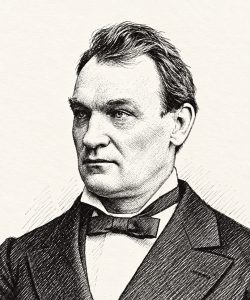
John G. Carlisle (1834–1910), Kentuckian and Secretary of the Treasury from 1893 to 1897, worked with the Kentucky Distillers’ Association to pass the Bottled-in-Bond Act of 1897. Illustration based on a period portrait.
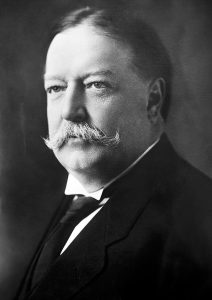
William Howard Taft (1857–1930), 27th President of the United States (1909–1913). His whiskey decision of 27 December 1909 allowed straight whiskey to be branded as Bourbon. Photo: George Grantham Bain, 1908. Library of Congress.
27 DECEMBER 1909
President William Howard Taft’s decision of 27 December 1909, issued under the Pure Food and Drug Act, is the first high federal text that treats Bourbon as an allowable brand for straight whiskey. Straight whiskey might be branded as such and, “as the facts may warrant,” as Bourbon or rye. Permission is not compulsion. Nelson County could still have sold fire-copper whisky under a house name. The making counties still had a choice. They would keep it until Repeal took the choice away.
─── “Permission is not compulsion.” ───
29 AUGUST 1935
Compulsion arrives after Repeal. The Federal Alcohol Administration Act of 29 August 1935, Public No. 401, 74th Congress, 49 Stat. 977, authorized labeling rules “as will provide the consumer with adequate information as to the identity and quality of the products.” The Act itself does not define bourbon. It gives the Secretary of the Treasury power to write standards that prohibit deception and require truthful class-and-type statements.
────────────────────────────────────────
51% CORN · 160 PROOF · NEW CHARRED OAK
Regulations published 2 April 1936, approved 18 January 1936 by Henry Morgenthau, Jr., Secretary of the Treasury, and signed by Josephine Roche as Acting Administrator of the Federal Alcohol Administration, defined bourbon whiskey as whiskey distilled at not more than 160 proof from a fermented mash of not less than 51 percent corn, and required bottles in interstate commerce to bear class and type. Goods that conformed to a standard had to carry its designation. The same regulations set aging minimums that stepped up over the following years and required the state of distillation on the label when the address would otherwise mislead. A 1938 amendment required new charred oak for whiskey produced on or after 1 March 1938.
The interim Federal Alcohol Control Administration, created by executive order in December 1933 under the National Industrial Recovery Act, had already begun writing labeling rules in February 1934. Joseph H. Choate Jr., a New York lawyer and its director, testified before the House Ways and Means Committee and helped shape the framework the 1935 Act carried forward. The standards of identity were Treasury staff work, not a named Kentucky sponsor.
The bill itself, H.R. 8870, came out of the House Ways and Means Committee under Thomas H. Cullen of New York. It moved through the Senate Finance Committee. The two Kentucky senators in 1935 were Alben Barkley of Paducah and Marvel M. Logan. Barkley was the bigger name—assistant to the majority leader, a member of Finance, a key New Deal floor manager, and later majority leader and vice president. Logan was the quieter of the two, a former Kentucky chief justice. Neither man sponsored the Act. No published hearing index or floor debate has been located in which either of them argued for the specific type-name “bourbon.” The powerful Kentucky voices were in the room. They were not the ones choosing the label.
Nor was the Secretary of the Treasury a Kentucky man. Henry Morgenthau, Jr., was born in New York City on 11 May 1891, the son of a German-Jewish real-estate family. He farmed in Dutchess County and became Franklin Roosevelt’s neighbor and friend at Hyde Park. He approved the 1936 regulations because the statute put the pen in his department. He did not invent the word, and he had no Kentucky connection that would explain the choice. The word that ended up on every Kentucky bottle was not chosen by anyone from Kentucky. It came from a New Yorker’s Treasury, codifying a river merchant’s label.
─── “The word that ended up on every Kentucky bottle was not chosen by anyone from Kentucky.” ───
That silence is evidence, not a hole. If a Kentucky senator had forced the type-name onto the regulations, the legislative history would show it. It does not. The pressure that made the compulsion necessary came from the trade—the same straight-whiskey houses that had fought rectifiers since the 1870s. Most of those houses were in Kentucky. Their influence ran through the industry and through earlier statutes, not through a floor speech in 1935 that named the drink.
Nelson County obeyed. The Filson Historical Society’s whiskey-label file for 1934–1949 includes “Uncle Bob Kentucky Straight Bourbon Whiskey,” bottled for Old Nelson County Distillery, Bardstown, and goods distilled and bottled by Old Heaven Hill Springs Distillery, Bardstown, Nelson County. Heaven Hill filled its first barrel on 13 December 1935 and, after the four-year bond, released Old Heaven Hill Bottled-in-Bond Bourbon in 1939. T. W. Samuels rebuilt at Deatsville in 1933–34 and sold bonded and 90-proof bottlings in a market that now required a type line. The word Elliott would not print in 1896 is, by 1939, the legal name of the Bardstown product.
That is not evidence that drinkers suddenly demanded a new word and the industry complied. The sequence is the other way. The Treasury required a type. The shelf said bourbon. The drinker learned to ask for what the label already named.
The other half of the same evidence is that the word was already on bottles before the freeze. It was not universal in the making counties—Atherton’s home stamps prove that—but it was common enough in the bottled trade that Repeal did not have to invent it. Surviving bottles and labels include Belmont Handmade Sour Mash Straight Bourbon Whiskey, distilled in Louisville in 1900 and bottled in the fall of 1917; Cedar Brook from 1892; Old Charter from 1890 and from 1896–1919; Old Forester teardrop bottles of the 1890s; a 1902 “Very Fine Old Whisky” in the Brown-Forman archive that later inspired Old Forester’s 1910 release; a Kentucky Tavern bottled-in-bond pint distilled in 1911 and bottled in 1924; and an Atherton Kentucky Straight Bourbon Whiskey distilled in 1917 and bottled in 1929 for medicinal sale under Julius Kessler. Those objects sit in the Frazier, in Bardstown Bourbon Company’s vintage library, in Buffalo Trace’s archive, and in private collections. They are the bottled cousins of Atherton’s 1889 Roanoke head.
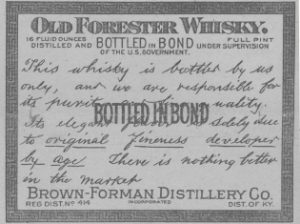
Figure 12 Old Forester Whisky, bottled in bond under U.S. government supervision, Brown-Forman Distillery Co., Dist. of Ky. The house word on this pre-Prohibition label is still whisky. The government stamp is already on the bottle. The later type line would make bourbon compulsory. Image: Old Forester legacy archive.
Figure 12 is worth sitting with. Even a Louisville house that later became synonymous with bottled bourbon printed whisky on a bonded label. The government strip is there. The type-name is not yet mandatory. That is the last moment of choice, captured on paper. After 1936 the same house would have to say bourbon on the class-and-type line whether it wanted the river word or the creek word.
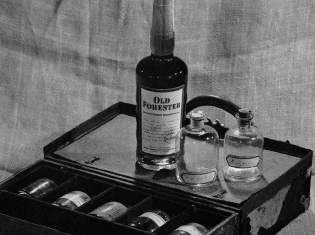
Early bottled Old Forester in a physician’s or salesman’s case. George Garvin Brown’s sealed bottle was itself an answer to the rectifier problem: if the cork and the label stayed intact, the buyer knew who was responsible for the liquid. Image: Old Forester legacy archive.
The final step in the transformation came in 1964. On 4 May 1964, Congress adopted Senate Concurrent Resolution 19, declaring bourbon whiskey “a distinctive product of the United States that is unlike other types of alcoholic beverages, whether foreign or domestic.” The resolution directed federal agencies to prohibit importation of whisky designated as “Bourbon whiskey” unless it met United States production standards. Representative John C. Watts of Kentucky—whose district included Bourbon County—introduced the companion House resolution in January 1963. Lewis Rosenstiel, founder of Schenley Distillers and a dominant figure in the postwar liquor industry, and his Bourbon Institute lobbied for the designation, mirroring the protection the United States already extended to Scotch, Canadian whisky, and Cognac.
─── “a distinctive product of the United States” ───
This is the moment the river word stopped being merely a label requirement and became a trade asset. The 1936 regulations forced Kentucky bottles to say “bourbon.” The 1964 resolution told the world that only American-made whiskey could legally bear the name. The creek word never got that protection. The river word did. Watts, at last, is a Kentucky name on a bourbon document. He arrives thirty years after the compulsion and a hundred and forty years after Stout & Adams put the county on a Maysville barrel.
─── “The creek word never got that protection. The river word did.” ───
So why do you keep calling my whisky bourbon? Because a merchant in Maysville needed a place-name on a barrel. Because Natchez already knew how to sell “Bourbon County.” Because the rectifier wars of the late nineteenth century forced straight distillers to defend their category against imitation, and “bourbon” was the trade word already attached to the real corn whiskey. Because after Repeal the federal label required a type, and the type it chose was the river word, not the creek word. Because no Kentucky senator put that type-name into the 1935 Act, and a New York Secretary of the Treasury signed the 1936 regulations that made it compulsory. Because in 1964 Congress locked the river word into international trade the way France had locked Cognac. Distillers in Nelson and LaRue inherited whisky from Scotch-Irish speech and from men such as Howard, Boone, Beam, Ford, and Atherton. Commission merchants, from 1821, sold Bourbon and Bourbon County whiskey as a geographic mark. “Old,” on those invoices, is age. Congress and the Treasury, in 1935–36, made bourbon whiskey a mandatory type. After that the drinker asked for what the bottle already said.
─── “That is the whole argument in iron.” ───
The 1889 Roanoke stamp is the page that holds all three languages at once. Five sister brands still speak the Rolling Fork. One wholesale brand already speaks the river. That is the whole argument in iron. Kentucky is proud of its bourbon heritage. We should not pretend the family always used the word. On this water the drink was whisky. Bourbon was a shipping name, then a legal type, then a protected national product. The word is older than Prohibition and younger than the still. It came down the water before it came home to the Rolling Fork River Valley. I print bourbon on the label because the government requires a type. I do not print it because Old Uncle Joe asked me to.
The river and the Treasury taught the rest of us to call it something else.
Sources & notes
- The 1820s advertisements reproduced here as Figures 3–10 are cited from the newspapers that printed them. Scans are reproduced from Robert F. Moss, “How Bourbon Really Got Its Name,” robertfmoss.com, 29 July 2020.
- Gerald Carson, The Social History of Bourbon (New York: Dodd, Mead, 1963); Charles K. Cowdery, Bourbon, Straight: The Uncut and Unfiltered Story of American Whiskey (Chicago: Madeira Press, 2004); Henry G. Crowgey, Kentucky Bourbon: The Early Years of Whiskeymaking (Lexington: University Press of Kentucky, 1971).
- Reid Mitenbuler, Bourbon Empire: The Past and Future of America’s Whiskey (New York: Viking, 2015); Michael R. Veach, Kentucky Bourbon Whiskey: An American Heritage (Lexington: University Press of Kentucky, 2013).
- Reid Mitenbuler, Bourbon Empire: The Past and Future of America’s Whiskey (New York: Viking, 2015); Michael R.
- Veach, Kentucky Bourbon Whiskey: An American Heritage (Lexington: University Press of Kentucky, 2013).
- Advertisement of Stout & Adams, Maysville, Western Citizen (Paris, Ky.), 1 May 1821. Discussed in Moss, “How Bourbon Really Got Its Name.”
- S. & H. P. Postlethwaite advertisement, Natchez Gazette, 7 August 1824. Scan reproduced from Moss, 2020.
- Sturgus & Miller advertisement, Natchez, 14 November 1825; J. W. Trembly advertisement, Natchez Landing, 23 January 1826. Scans reproduced from Moss, 2020.
- Louisiana State Gazette, 12 April 1824; Courrier de la Louisiane, 17 April 1826. Scans reproduced from Moss, 2020.
- Paris–Bourbon County institutional accounts give Jacob Spears’s marketed name as “Best Old Whiskey.” See “Bourbon Origin Story,” Paris/Bourbon County Tourism; Kentucky Historical Marker 2295. Moss identifies the 1824 “Spears” as likely Solomon Spears, Jacob’s son.
- Montgomery & Platt, Charleston Daily Courier, 10 April 1827; S. Davenport & Co., Charleston Daily Courier, 14 October 1828. Scans reproduced from Moss, 2020.
- Sam Carpenter Elliott, The Nelson County Record: An Illustrated Historical & Industrial Supplement, New Year, 1896 (Bardstown: Record Printing Co.; repr. Nazareth Archival Center, 1986). Distillery sketches transcribed from that issue by Bettye Jo Boone, Straightbourbon.com, 2003.
- Facsimiles of the Brands of the J. M. Atherton Company, Meyer Brothers Drug Co. catalogue, 1889.
- Act of 3 March 1897, ch. 379, 29 Stat. 626 (Bottled-in-Bond Act).
- Michael R. Veach, “The Fight For Bottled-In-Bond,” bourbonveach.com, 10 August 2020; Veach, “Rectifiers In The 19th Century,” bourbonveach.com, 23 May 2022; Veach, “A History of Bourbon Regulations,” bourbonveach.com, 13 November 2023.
- Macy Scheck and Daniel J. Smith, “Straight Whiskey and Bad Regulation,” Regulation (Cato Institute), Fall 2023, 14–20, reviewing estimates that rectified whiskey constituted 50–90 percent of the U.S. market in the decades before Prohibition.
- Veach, “The Fight For Bottled-In-Bond”; Veach, Kentucky Bourbon Whiskey, 69–75. On Carlisle’s Kentucky background and the KDA’s lobbying, see Veach, “Politics And Kentucky Distilling,” bourbonveach.com, 1 November 2021.
- The rectifier opposition included George Garvin Brown and Isaac Wolfe Bernheim, both of whom later owned distilleries. Their objection was that a bonded-purity seal would give owning distillers an unfair market advantage. See Veach, “The Fight For Bottled-In-Bond.”
- President William Howard Taft, decision of 27 December 1909, under the Pure Food and Drugs Act of 1906, 34 Stat. 768. The decision treated “Bourbon” as an allowable brand for straight whiskey “as the facts may warrant.” For the industry fight that produced the decision, see Wallace A. Russell, “Controls Over Labeling and Advertising of Alcoholic Beverages,” Law and Contemporary Problems 7, no. 4 (Autumn 1940): 645–664.
- Federal Alcohol Administration Act, Pub. L. No. 401, 74th Cong., 49 Stat. 977 (29 August 1935), §5(e). The Act authorized the Secretary of the Treasury to prescribe labeling regulations that would “provide the consumer with adequate information as to the identity and quality of the products.” It does not itself define “bourbon.”
- Federal Alcohol Administration, Regulations No. 5 Relating to Labeling and Advertising of Distilled Spirits, Federal Register 1, no. 14 (2 April 1936): 92ff., approved 18 January 1936 by H. Morgenthau, Jr., Secretary of the Treasury, and signed by Josephine Roche, Acting Administrator. Class 2 defined “bourbon whiskey” as whiskey distilled at not exceeding 160° proof from a fermented mash of not less than 51 percent corn.
- On the 1938 amendment requiring new charred oak for whiskey produced on or after 1 March 1938, see Federal Register, 2 March 1938, Regulations No. 5, Amendment No. 5, approved by Henry Morgenthau, Jr. Veach notes the change is often described as a jobs measure associated with Rep. Wilbur Mills of Arkansas. Veach, “A History of Bourbon Regulations.”
- Executive Order 6474 (4 December 1933) established the Federal Alcohol Control Administration under the National Industrial Recovery Act, with Joseph H. Choate, Jr., as chairman. FACA issued distilled-spirits labeling regulations of a general nature on 6 February 1934 and a revised pamphlet on 13 May 1935. See Russell, “Controls Over Labeling,” 645–652.
- H.R. 8870, 74th Cong., 1st Sess., reported from the House Committee on Ways and Means by Thomas H. Cullen of New York, H.R. Rep. No. 1542 (17 July 1935). Senate hearings were held before the Committee on Finance, 26–29 July 1935. No published hearing index or floor debate has been located in which Sen. Alben W. Barkley or Sen. Marvel M. Logan of Kentucky argued for the specific type-name “bourbon.” Barkley sat on Finance and was assistant to Majority Leader Joseph T. Robinson; Logan was the quieter of the two Kentucky seats. Their presence is not the same as authorship of the word.
- Filson Historical Society, whiskey-label collections Mss. A M647a and Mss. A W576, “Bourbon labels, 1850s, 1934–1949.” On Heaven Hill’s first barrel (13 December 1935) and the 1939 bonded release, and on T. W. Samuels at Deatsville, see standard house histories and the Filson file cited above.
- Surviving pre-Prohibition bottles and labels that already carry “bourbon” or “straight bourbon” include Belmont Handmade Sour Mash Straight Bourbon Whiskey distilled 1900 and bottled Fall 1917 (Louisville); Cedar Brook 1892; Old Charter 1890 and 1896–1919; Old Forester teardrop bottles of the 1890s and a 1902 “Very Fine Old Whisky” that later inspired Old Forester’s 1910 release; Kentucky Tavern bottled-in-bond pint, distilled 1911 and bottled 1924; and an Atherton Kentucky Straight Bourbon Whiskey distilled 1917 and bottled 1929 for medicinal sale. See Courier-Journal, “What are the oldest bottles of Kentucky bourbon,” 17 September 2024; Frazier History Museum bourbon collection notes on Atherton 1929.
- S. Con. Res. 19, 88th Cong., adopted 4 May 1964; companion H. Con. Res. 57 introduced 24 January 1963 by Rep. John C. Watts of Kentucky. The resolution declared bourbon whiskey “a distinctive product of the United States” and asked federal agencies to prohibit importation of whisky so designated unless it met U.S. standards. See VinePair, “How Bourbon Became a ‘Distinctive Product of the United States’”; Reid Mitenbuler, Bourbon Empire, on Lewis Rosenstiel and the Bourbon Institute.